Jammer Deals | Affordable Picks | Free Shipping
Your privacy is our top concern! We offer dependable solutions to safeguard you from unauthorized monitoring, ensuring your confidentiality in any setting.
Jammer Deals | Affordable Picks | Free Shipping
Your privacy is our top concern! We offer dependable solutions to safeguard you from unauthorized monitoring, ensuring your confidentiality in any setting.
When people search for a cell phone jammer, one of the most common questions is:
“Will this work with my carrier?”
A Verizon customer may wonder if a signal blocking equipment works on Verizon phones.
An AT&T user may search for an AT&T-specific signal blocker.
T-Mobile customers often ask whether newer 5G phones require different equipment.
The short answer is:
A device to block cellular phone does not target AT&T, Verizon, or T-Mobile directly. It works by affecting the radio frequencies used for mobile communication.
A common misunderstanding is that a phone scrambler blocks a SIM card or a specific carrier.
It does not.
A smartphone communicates with a nearby cellular tower through radio frequency signals. Whether the phone uses AT&T, Verizon, or T-Mobile, the connection depends on supported frequency bands.
The basic relationship between a phone, carrier network, and signal blockers can be understood as follows:
| Component | Role in Mobile Communication |
|---|---|
| Smartphone | Sends and receives wireless signals through supported frequency bands |
| Cellular Tower | Provides the connection between the phone and the carrier network |
| Mobile Carrier | Manages voice, text, and data services through its network infrastructure |
| Signal Jammer | Interferes with the radio frequency communication channels being used |
The key factor is frequency coverage, not the carrier brand.
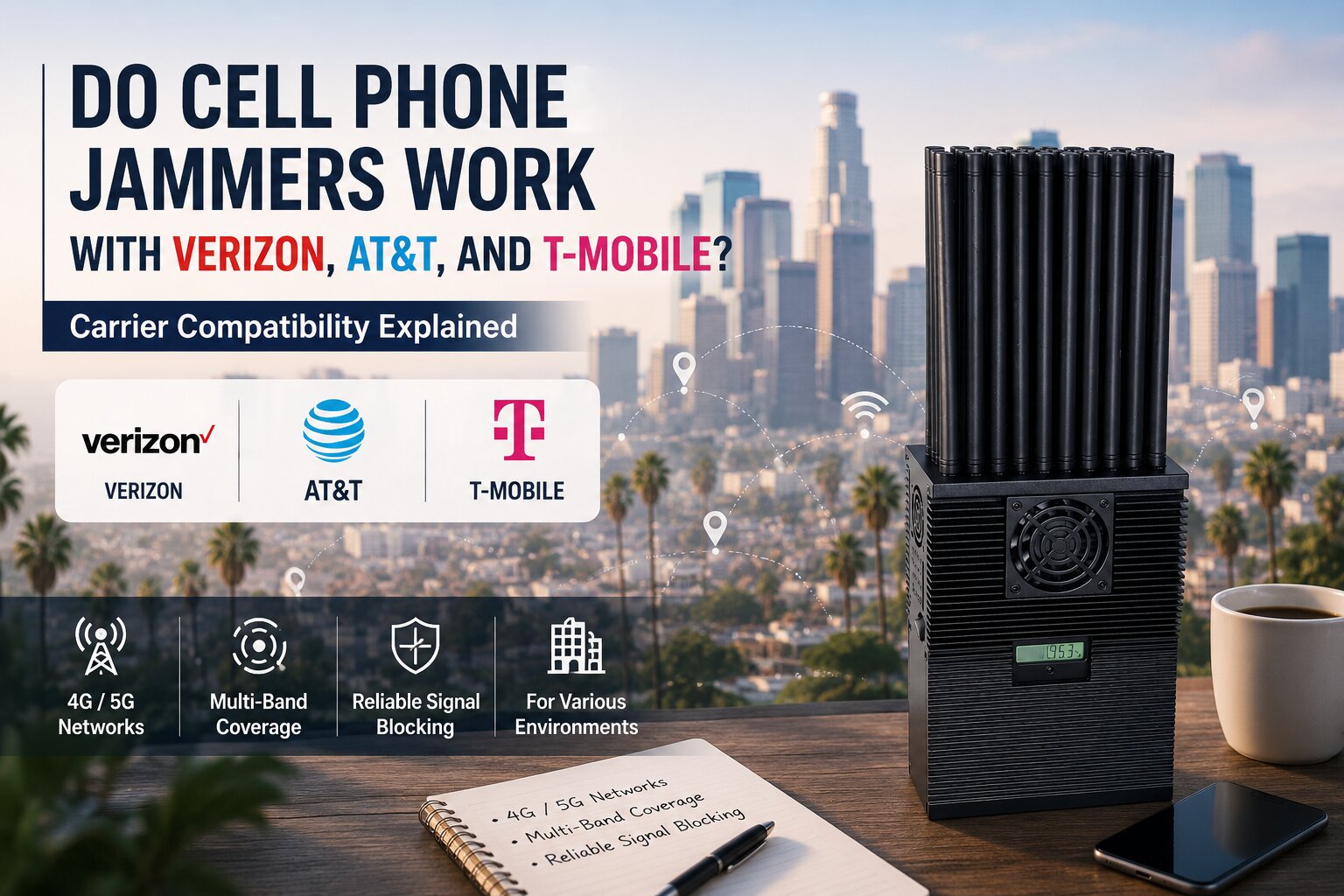
Yes, a properly configured cell phone jammer.
Verizon operates a large LTE and 5G network using a combination of low-band, mid-band, and high-band spectrum. Its 5G network includes bands such as n5, n77, and mmWave bands in some areas.
For Verizon users, important considerations include:
| Verizon Network Factor | Why It Matters |
|---|---|
| 4G LTE bands | Many phones still rely on LTE connectivity |
| 5G mid-band spectrum | Increasingly important for modern devices |
| Local signal strength | Stronger tower signals may affect performance |
| Indoor environment | Walls and building materials influence RF conditions |
The same phone used in an area with strong cellular coverage in downtown Los Angeles may perform very differently in the morning than it does in the evening.
The carrier alone does not determine results.
AT&T customers often ask whether they need an AT&T-specific jamming device.
The answer is generally no.
AT&T phones communicate through supported cellular frequencies rather than a unique “AT&T signal”. Modern AT&T networks include multiple LTE and 5G frequency bands, including low-band and mid-band spectrum used for nationwide coverage.
When selecting a signal blocking device talking in mobile for AT&T environments, consider:
| Consideration | Example |
|---|---|
| Network generation | 4G LTE, 5G |
| Frequency range | Supported cellular bands |
| Coverage area | Room, vehicle, or larger space |
| Device design | Portable or fixed installation |
A multi-band device is usually more versatile because phones automatically select available networks and bands.
T-Mobile has become one of the most aggressive 5G network operators in the United States, with strong use of mid-band spectrum such as 2.5GHz.
This means older single-band equipment may not match the way modern T-Mobile devices connect.
Important factors include:
| T-Mobile Network Feature | Impact |
|---|---|
| 5G expansion | More frequency combinations |
| Mid-band spectrum | Higher capacity connections |
| Modern smartphones | Automatic band switching |
A customer using a recent iPhone or Samsung Galaxy device may connect differently from an older LTE phone.
This is why buyers should check frequency support, not simply search for a “T-Mobile signal blocking equipment.”
Many users expect to find separate products:
But cellular networks do not work that way.
A better way to evaluate a disruptor is:
| Wrong Question | Better Question |
|---|---|
| Does it block Verizon? | What frequencies does it support? |
| Does it work with AT&T? | Does it cover the required cellular bands? |
| Is it a T-Mobile signal silencer? | Does it support modern mobile networks? |
The multi-band mobile phone frequency blockers can support different carrier environments when its frequency coverage matches the signals being used.
Of course, you can also purchase our portable global 32-band frequency jammer. It offers full-spectrum coverage, blocking common signals such as 4G, Wi-Fi, and GPS, as well as 5G and even the less common Wi-Fi 6E/7E. In addition to these, it easily handles UHF, VHF, and RC signals.
Instead of choosing a jammer based only on your carrier, check these specifications:
| Feature | Why It Matters |
|---|---|
| Frequency Coverage | Determines supported mobile signals |
| Number of Bands | More bands provide broader compatibility |
| Output Power | Influences operating range |
| Antenna Design | Affects signal transmission capability |
| Cooling System | Important for longer operation |
| Battery Capacity | Important for portable models |
The environment matters as much as the carrier.
AT&T, Verizon, and T-Mobile all operate large and constantly evolving wireless networks. As smartphones become more advanced, carrier compatibility is less about the name printed on your phone bill and more about the frequencies your device uses.
When choosing a signal scrambler, focus on:
Understanding these factors helps buyers choose equipment based on real wireless conditions instead of simply searching for a carrier-specific product.