Jammer Deals | Affordable Picks | Free Shipping
Your privacy is our top concern! We offer dependable solutions to safeguard you from unauthorized monitoring, ensuring your confidentiality in any setting.
Jammer Deals | Affordable Picks | Free Shipping
Your privacy is our top concern! We offer dependable solutions to safeguard you from unauthorized monitoring, ensuring your confidentiality in any setting.
Some customers who purchase a drone jammer ask the same question after testing their equipment: “The drone is affected, but why does it still stay in the air?”
This is one of the most common misunderstandings. Many people assume that if GPS signals are blocked, the quadcopter should immediately stop flying.
However, GPS is only one part of a quadcopter’s navigation system. Modern UAVs combine satellite positioning, onboard sensors, cameras, and flight control software to maintain stability.
A modern quadcopter is not controlled by a single signal, it usually involves several independent systems:
| UAV System | Main Function |
|---|---|
| GPS/GNSS | Outdoor positioning and navigation |
| Control link | Communication between remote controller and drone |
| Video link | Real-time image transmission |
| IMU sensors | Flight stability and movement detection |
| Optical sensors | Position assistance |
When a UAV frequency blocker affects one type of signal, the UAV may still receive information from other onboard systems.
This is why a quadcopter may appear to continue operating even when GPS-related functions are affected.
A common assumption is:
No GPS = No flight
However, GPS mainly provides location information.
It helps a drone understand:
The actual process of keeping the aircraft balanced depends heavily on:
Flight controller
Gyroscope
Accelerometer
Optical sensors
A simple comparison:
| Technology | Main Question |
|---|---|
| GPS | Where am I? |
| IMU | How am I moving? |
| Camera sensors | What is around me? |
| Flight controller | How should I adjust? |
This explains why the loss of GPS signals caused by a FPV system signal blocker does not always result in an immediate interruption of the flight.
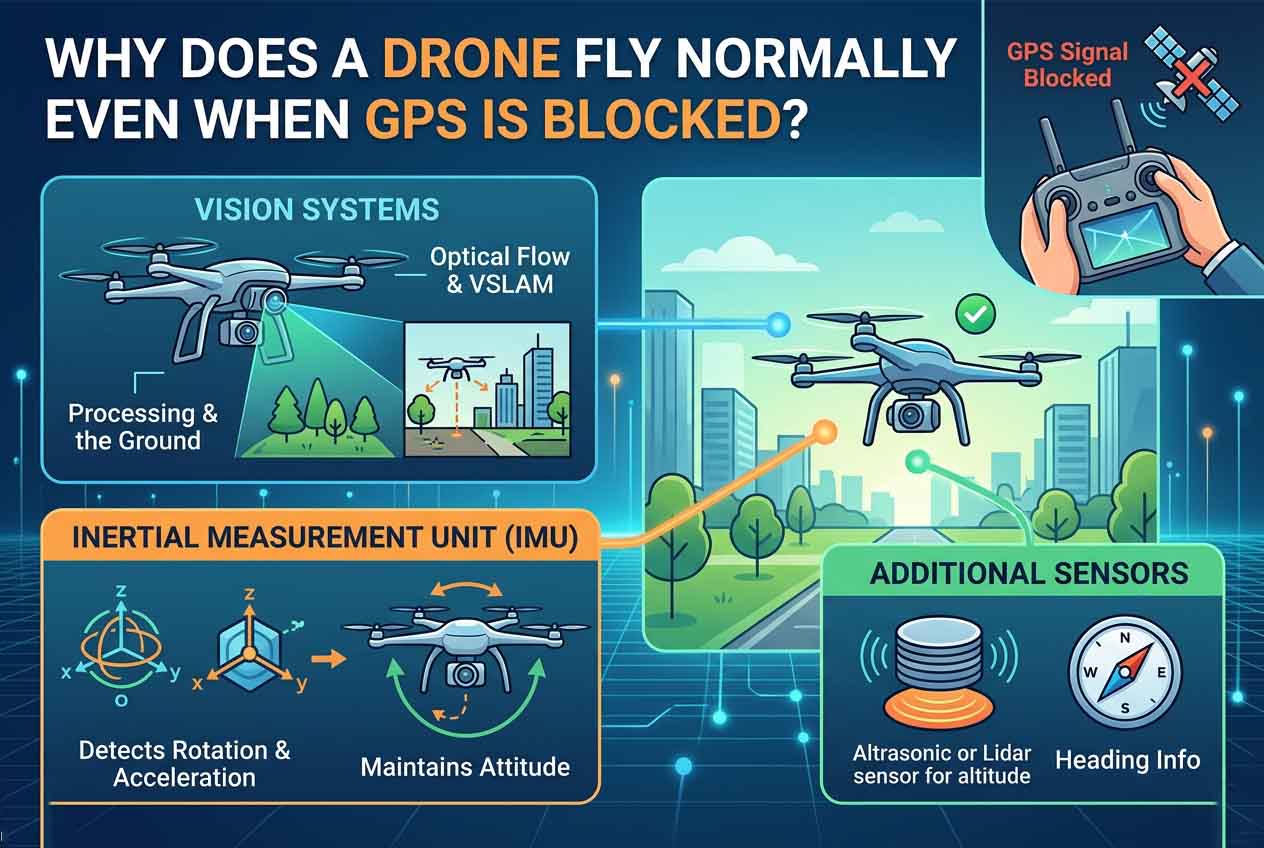
1. The quadcopter May Maintain Basic Stability
Many UAVs can temporarily rely on internal sensors to keep balance.
The flight controller continuously analyzes:
This allows the quadcopter to remain airborne even when satellite positioning becomes unreliable.
2. The Drone May Switch Flight Modes
Different quadcopters have different safety designs.
Possible changes include:
| Condition | Possible Response |
|---|---|
| GPS accuracy decreases | Less accurate positioning |
| GPS unavailable | Switch to alternative stabilization |
| Control connection changes | Activate preset safety functions |
The exact behavior depends on the drone manufacturer, firmware, and environment.
Take a drone jammer capable of blocking GPS and Wi-Fi signals, for example: it features two modes—one where the quadcopter continues to fly (the "automatic return-to-home" mode we discussed), and another that forces the drone to land.
Another reason a UAV may continue flying is that GPS is not the same as the communication link.
A quadcopter typically uses different wireless channels for:
Navigation
Remote control
Video transmission
Telemetry
For example:
| Signal Type | Purpose |
|---|---|
| GPS/GNSS | Position information |
| 2.4GHz | Common control and data transmission |
| 5.8GHz | Video and communication links on many systems |
| Other bands | Depending on UAV design |
This is why professional anti-drone jamming equipment is typically designed to cover multiple frequency bands, rather than just GPS-related signals.
A drone continuing to fly after GPS interference does not necessarily mean a drone jammer has no effect. It usually means the drone is using additional systems beyond GPS to maintain stability.
GPS, IMU sensors, optical positioning, and communication links all play different roles in modern UAV operation.