Jammer Deals | Affordable Picks | Free Shipping
Your privacy is our top concern! We offer dependable solutions to safeguard you from unauthorized monitoring, ensuring your confidentiality in any setting.
Jammer Deals | Affordable Picks | Free Shipping
Your privacy is our top concern! We offer dependable solutions to safeguard you from unauthorized monitoring, ensuring your confidentiality in any setting.
A phone can have strong service on one street and struggle inside a building just a few blocks away.
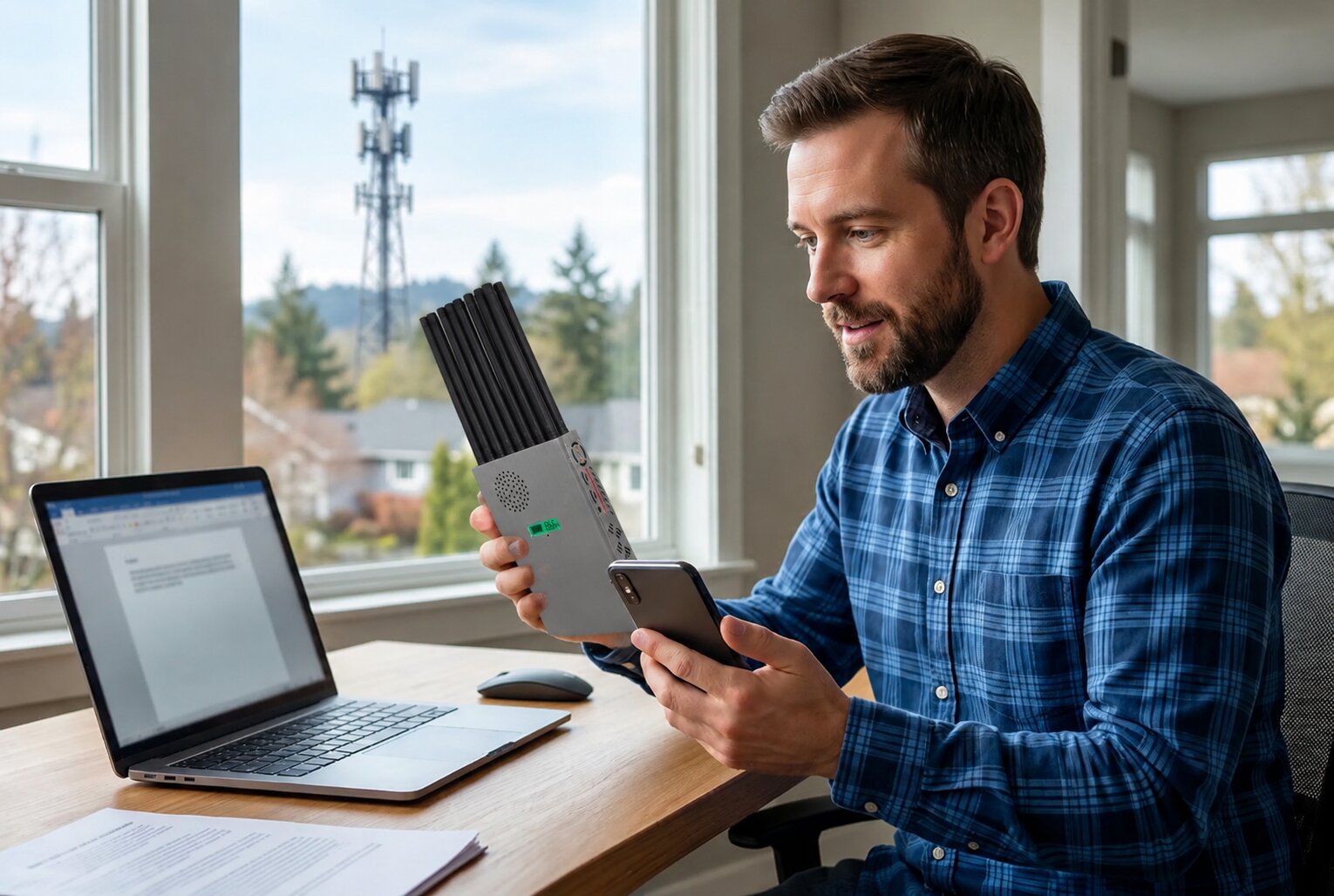
This often raises a practical question: *does the distance from a cell tower affect mobile phone blocker performance?
Yes, tower distance can influence the cellular environment, but it is not the only factor. The phone's signal strength, frequency band, building materials, location, and surrounding RF activity can all change how cellular signal blocking behaves.
A cell phone communicates with a nearby cellular network through radio signals. As the distance from a serving cell tower increases, the received signal can generally become weaker because of propagation loss.
For a 16-antenna 18 band handheld cellular signal jammer, this matters because interference is experienced at the phone's location—not simply at a certain distance from the tower.
| Location | Typical RF consideration |
|---|---|
| Near a cell tower | Cellular signal may be relatively strong |
| Farther from a tower | Greater propagation loss may occur |
| Concrete building | Walls can weaken cellular signals |
| Basement or parking garage | Indoor attenuation can be significant |
| Open outdoor area | Fewer physical obstructions |
Not automatically.
If a phone already receives a weak cellular signal, additional interference may have a more noticeable effect. A stronger cellular signal can present a different RF environment.
However, saying farther from the tower means a jammer always works better is too simplistic.
Modern U.S. networks use multiple spectrum bands. Low-band cellular signals generally provide broader coverage and better building penetration, while higher-frequency signals have shorter propagation distances and can be more easily blocked by physical obstacles.
Imagine two offices:
Looking only at the map, Office B appears to have the disadvantage. In practice, its indoor cellular environment can be affected heavily by walls, floors, metal structures and coated glass.
The same principle applies to a signal blocker.
Tower distance is only one variable. Other factors include:
The FCC's mobile broadband coverage data uses RSRP in dBm as a signal-strength measure for 4G LTE and 5G-NR coverage modeling, rather than relying on the signal bars shown on a phone.
This explains a common observation: the same 5G Internet jammer may produce different results at two locations.
The difference may have little to do with the scrambler device itself. One site could have stronger cellular coverage, a different serving band, fewwer physical obstructions, or a different network configuration.
In other words:
Tower distance affects the RF environment, but it does not determine cellular phone blocker performance by itself.
The distance between a phone and a cell tower can affect cellular signal strength, but it is only one part of the picture. Frequency, building materials, network conditions and phone location can all influence real-world cellular performance.
That is why cell phone scrambler devices range should never be judged by tower distance alone.