Jammer Deals | Affordable Picks | Free Shipping
Your privacy is our top concern! We offer dependable solutions to safeguard you from unauthorized monitoring, ensuring your confidentiality in any setting.
Jammer Deals | Affordable Picks | Free Shipping
Your privacy is our top concern! We offer dependable solutions to safeguard you from unauthorized monitoring, ensuring your confidentiality in any setting.
Not every drone security challenge happens around a building.
Some situations take place at airports, industrial facilities, and restricted sites where permanent protection makes sense.
Others happen in remote areas, temporary operation zones, or locations where installing equipment is not practical.
This difference creates two distinct approaches to counter-quadcopter protection.
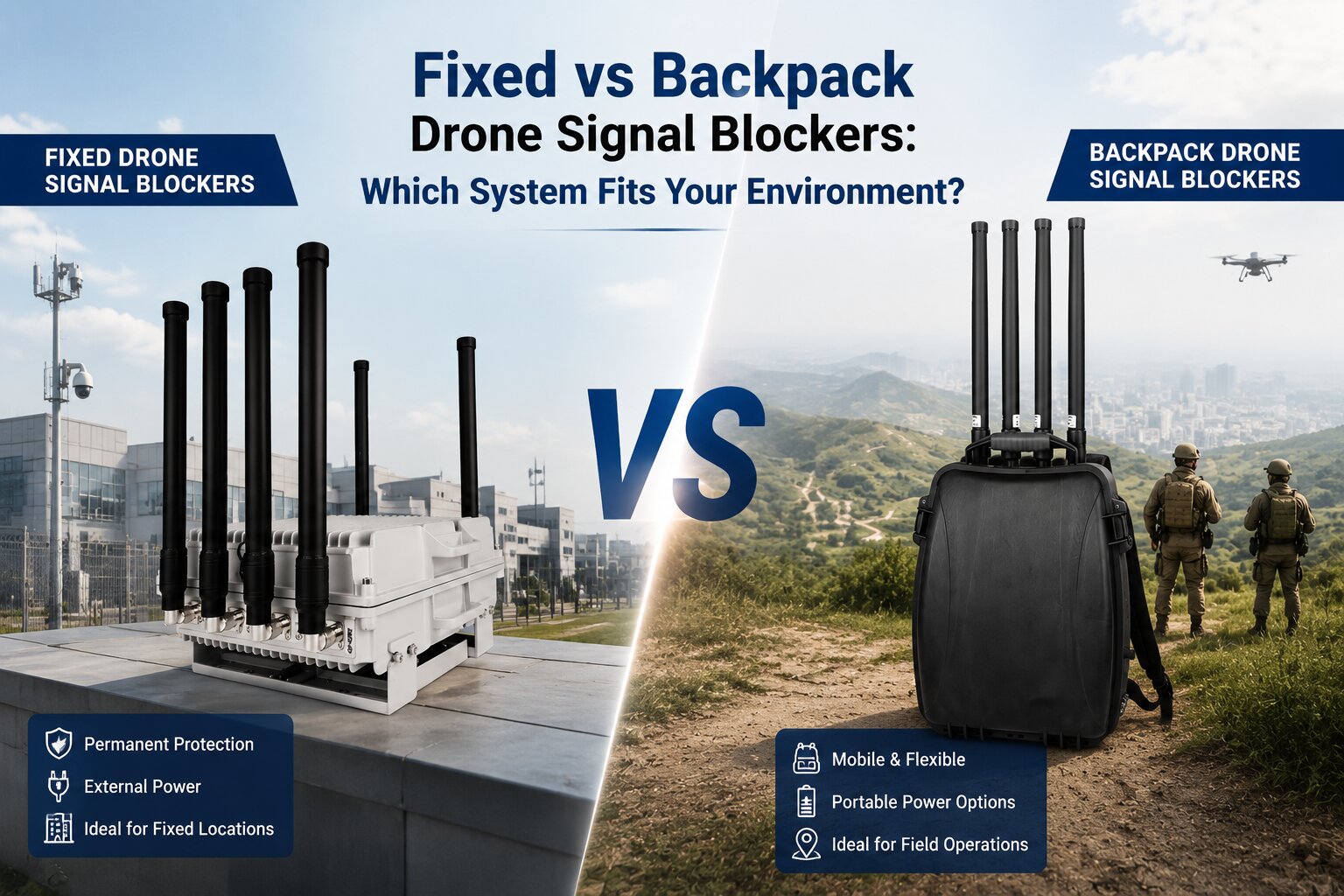
Fixed anti-drone systems provide continuous coverage around established areas.
While backpack FPV system signal blocker offer flexibility when teams need to bring protection into changing environments.
Fixed jamming device are commonly found around locations where security boundaries remain stable.
Examples include:
These environments usually have several advantages:
Permanent operating areas
Available power infrastructure
Dedicated equipment locations
Long-term security requirements
Fixed security measures enable security teams to maintain a continuous presence in a specific area.
Permanent systems work well when the environment supports permanent equipment.
However, many security situations happen outside traditional facilities.
Examples include:
Remote inspection areas
Outdoor operations
Temporary security zones
Large open spaces
Areas without reliable power access
In these locations, the challenge is not the lack of a permanent protection target.
The challenge is the lack of infrastructure.
A location may require UAV protection but may not have:
| Requirement | Possible Limitation |
|---|---|
| Power supply | No stable electrical connection |
| Mounting location | No permanent structure available |
| Installation time | Limited time for equipment setup |
| Long-term presence | Protection is only temporarily needed |
This is where portable equipment becomes more practical.
A portable device that blocks UAV provides mobility when a fixed installation is not suitable.
Our 4-band backpack anti-drone Interceptor doesn't need to be fixed in one location; instead, it can be moved between different areas by the operator.
This type of system is commonly considered in situations involving:
The main difference is deployment flexibility.
A fixed system stays with the protected site.
A backpack system travels with the people responsible for protection.
Outdoor environments often present challenges that do not exist in cities or facilities.
A remote area may have:
Uneven terrain
Limited infrastructure
Changing operation points
Difficult access routes
For example, a team inspecting infrastructure across a large rural area may not have a practical location for permanent equipment installation.
Transporting a fixed system between locations would require additional time, equipment, and preparation.
A backpack platform reduces the dependency on fixed facilities.
Temporary Operations Do Not Always Require Permanent EquipmentSome security requirements exist only for a short period.
Examples:
Outdoor public events
Temporary restricted zones
Short-term field operations
Emergency response activities
Installing permanent equipment for a temporary requirement may not always match the operational timeline.
Portable counter-UAS equipment provides another approach:
Arrive → Deploy → Operate → Relocate
The ability to change locations quickly becomes valuable when the protection area changes frequently.
The choice depends on the environment, not simply technical specifications.
| Category | Fixed | Backpack |
|---|---|---|
| Main Application | Permanent locations | Mobile operations |
| Location | Buildings and facilities | Outdoor and changing environments |
| Installation | Requires setup area | Faster deployment |
| Power | External power sources | Portable power options |
| Operation Style | Continuous protection | Flexible field use |
| Typical Users | Facility security teams | Mobile operators |
Both categories have their place.
A large facility may require fixed protection around important areas.
A field team may require portable equipment when operating away from established infrastructure.