Jammer Deals | Affordable Picks | Free Shipping
Your privacy is our top concern! We offer dependable solutions to safeguard you from unauthorized monitoring, ensuring your confidentiality in any setting.
Jammer Deals | Affordable Picks | Free Shipping
Your privacy is our top concern! We offer dependable solutions to safeguard you from unauthorized monitoring, ensuring your confidentiality in any setting.
A traveler checks into a vacation rental and notices a small device facing the bed.
It looks like a digital clock, a USB charger, or a smoke detector. Nothing appears unusual, but the device has a tiny camera lens hidden inside.
This type of situation has changed the way many people think about wireless devices.
Small WiFi cameras are easier to install, easier to connect, and harder to notice than traditional security cameras. A device that fits in the palm of a hand can connect to a wireless network and send video remotely.
It is not simply a camera with a lens. Many models rely on Wi-Fi communication to provide remote access features.
| Function | Wireless Role |
|---|---|
| Live video viewing | Sends video through a Wi-Fi connection |
| Remote access | Communicates with mobile apps or cloud services |
| Motion alerts | Transfers notifications through a network |
| Device control | Receives commands through wireless signals |
Many compact cameras use 2.4GHz WiFi because it offers longer range and better compatibility with common routers. Some newer models also support 5GHz WiFi for faster data transfer.
This wireless capability is convenient for legitimate security products.
However, the same technology can also be misused when a camera is installed without permission.
The size of cameras has changed dramatically.
Years ago, security cameras were usually visible and professionally installed.|
Today, compact cameras can be built into everyday objects such as:
According to a report from Parks Associates, more than half of U.S. broadband households now own at least one connected smart home device, showing how quickly wireless technology has entered private spaces.
The issue is not that every Wi-Fi camera is unsafe. Many are valuable tools for security and monitoring.
The concern comes from unknown, unauthorized, or improperly placed wireless devices.
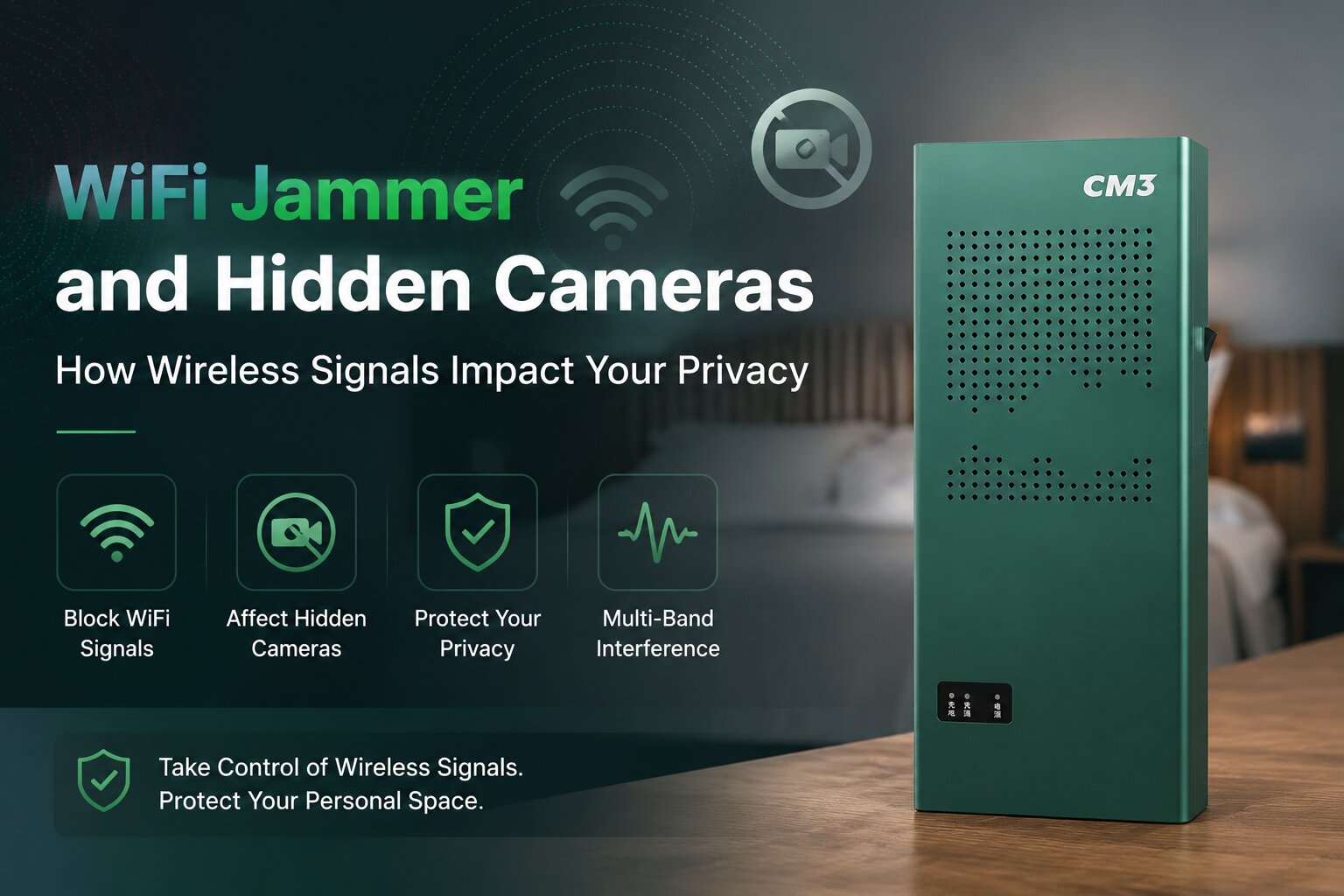
A camera feed jamming device works by creating interference within specific wireless frequency ranges.
Since many smart cameras depend on wireless communication, their connection can be affected when interference occurs on the frequencies they use.
The relationship is straightforward:
| Device | Main Function |
|---|---|
| Smart Camera | Uses wireless signals to transmit data |
| Router | Provides network communication |
| Smartphone App | Provides remote access |
| WiFi Jammer | Creates wireless frequency interference |
However, Wi-Fi cameras are not identical. The result can vary depending on:
Operating frequency
Camera model
Network setup
Signal strength
Distance between devices
For this reason, users researching devices for WiFi camera jamming concerns should pay attention to frequency coverage rather than only looking at output power.
Different environments require different types of wireless signal control. When comparing network blocker, users usually focus on several practical factors.
A jamming device that can shut down all data and wifi signals should match the wireless bands users are concerned about.
Common wireless frequencies include:
Models with independent frequency control allow users to manage different signal bands separately.
Portable designs are often preferred for users who need to move the device between locations. For example, the 2.4/5 GHz WiFi and Bluetooth Signal Blocker ensures portability while also providing 3-4 hours of battery life.
Higher-output devices generate more heat, so ventilation and cooling design can affect long-term operation.