Jammer Deals | Affordable Picks | Free Shipping
Your privacy is our top concern! We offer dependable solutions to safeguard you from unauthorized monitoring, ensuring your confidentiality in any setting.
Jammer Deals | Affordable Picks | Free Shipping
Your privacy is our top concern! We offer dependable solutions to safeguard you from unauthorized monitoring, ensuring your confidentiality in any setting.
A tracking device does not experience the same signal environment everywhere it goes.
A vehicle parked beside a warehouse, driving between skyscrapers, or crossing an open highway is interacting with completely different signal environments.
The difference is not always the device itself — it is often the conditions around it.
From satellite visibility to nearby structures, many factors can influence anti tracking GPS jammers performance.
Many people assume GPS signals are simply “on” or “off.” In reality, location reception changes constantly.
Location receivers depend on signals from satellites located hundreds of miles above Earth.
These signals are extremely weak by the time they reach the ground, which means the surrounding environment can have a noticeable impact.
For example:
A vehicle in an open area may have a clearer view of satellites.
A car surrounded by tall buildings may receive reflected signals.
A vehicle traveling at highway speed experiences constantly changing signal conditions.
This is why the same GPS tracker blocker can behave differently in different locations.
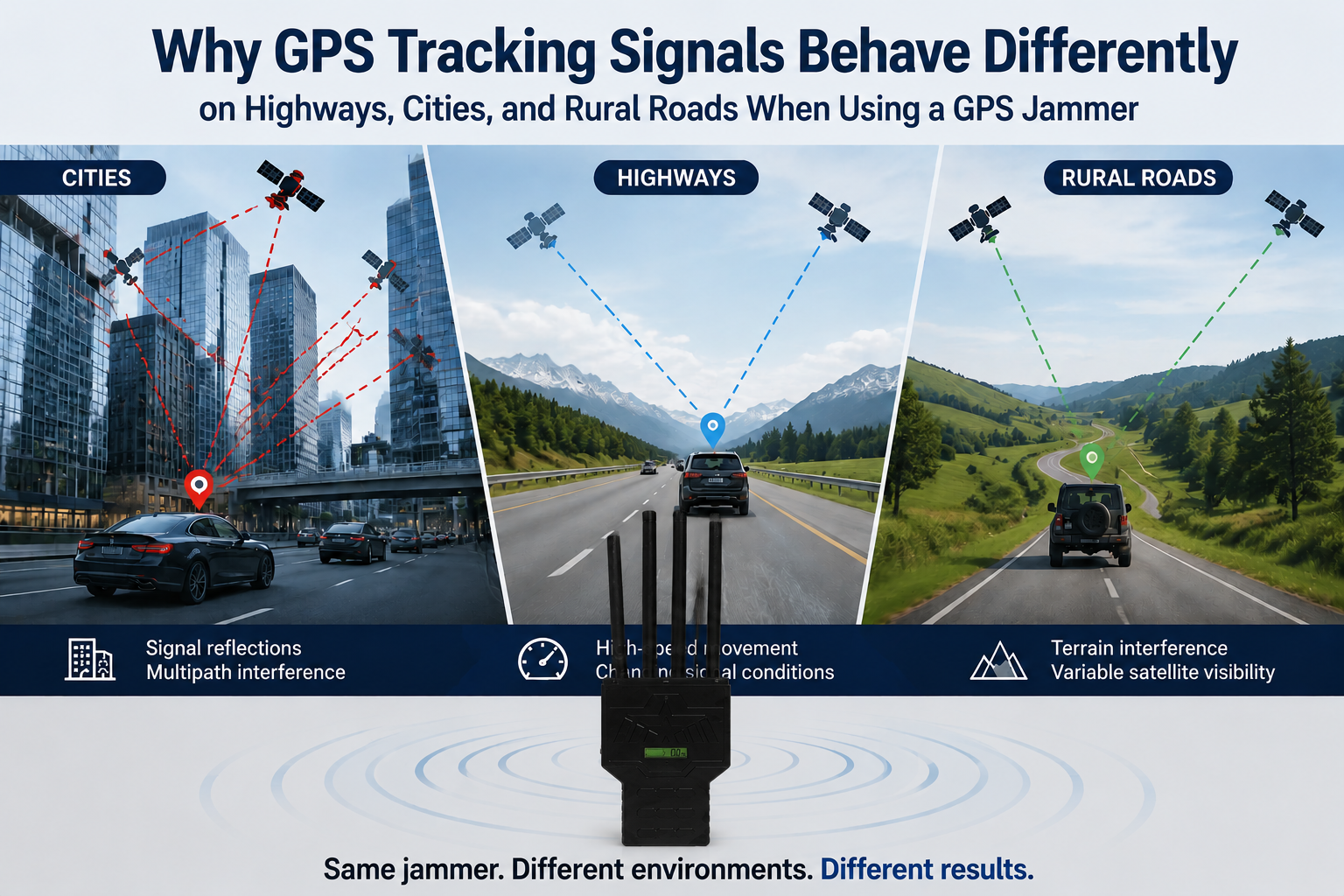
Tall buildings, bridges, tunnels, and glass structures can reflect satellite signals before they reach a receiver.
This effect, known as multipath interference, can cause signals to arrive from unexpected directions.
A vehicle driving through Manhattan, Los Angeles, or Chicago is dealing with a very different positioning environment compared with a vehicle traveling through open farmland.
Urban areas usually have:
For a vehicle GPS jammer, these conditions can influence how signals behave and how the receiver responds.
At first glance, highways seem like the easiest environment for location signals because there are fewer buildings.
However, highway driving introduces another variable: movement.
A vehicle traveling at 60–70 mph is constantly changing position relative to satellites, terrain, and surrounding objects.
A long highway trip may include:
The signal environment can change within minutes.
Open countryside often provides excellent satellite visibility, but that does not mean every rural location behaves the same.
A flat highway in Kansas and a mountain road in Colorado are both rural environments, but the GPS conditions are completely different.
Terrain, elevation, and satellite visibility all affect signal reception.
In open areas, receivers may have stronger access to satellite signals because there are fewer obstacles.
However, in other cases, hills, trees, or terrain can also affect signals.
Modern vehicles contain:
The position of antennas and electronic components can affect how signals enter and move through the vehicle.
Traditional GPS tracking is no longer limited to one satellite system.
GPS (United States)
Galileo (Europe)
GLONASS (Russia)
BeiDou (China)
Newer receivers may also support additional GPS bands such as L2 and L5, improving positioning accuracy in difficult environments.
These multi-band GPS signals require broader frequency coverage, making products like the sky blue full-band GPS jammer suitable for different GPS frequency bands.
Many buyers focus on advertised range or output power when comparing GPS jamming device.
However, real-world performance depends on several factors:
| Factor | Why It Matters |
|---|---|
| Frequency coverage | GPS systems operate across multiple frequency bands |
| Antenna design | Affects signal distribution and stability |
| Operating environment | Buildings, terrain, and vehicles change signal conditions |
| Device cooling | Stable operation requires proper heat management |
| Installation position | Placement affects practical performance |
A higher specification does not automatically mean identical performance everywhere.
The environment where a device operates matters just as much as the hardware itself.
A GPS signal does not exist in isolation. Every road, landscape, and vehicle creates a different environment for satellite communication.
Whether driving through a city, crossing a highway, or traveling through rural areas, changes in surroundings can influence how GPS tracking signals behave.