Jammer Deals | Affordable Picks | Free Shipping
Your privacy is our top concern! We offer dependable solutions to safeguard you from unauthorized monitoring, ensuring your confidentiality in any setting.
Jammer Deals | Affordable Picks | Free Shipping
Your privacy is our top concern! We offer dependable solutions to safeguard you from unauthorized monitoring, ensuring your confidentiality in any setting.
Many users assume that strong signal bars mean the device should still maintain calls, mobile data, and network access. However, a smartphone does not rely on signal strength alone.
It must continuously exchange data with nearby cellular towers, and this communication process can be affected when RF interference appears on the same frequency bands.
Under a portable 5G cell phone jammer, a phone may still detect cellular signals from a nearby tower, but the connection between the device and the network may become unstable. This can lead to situations such as:
The reason is that cellular communication requires a clean two-way link. A phone needs both a signal from the tower and a reliable return path back to the network. When interference affects these wireless channels, the phone may continue showing signal bars while losing the ability to maintain normal communication.
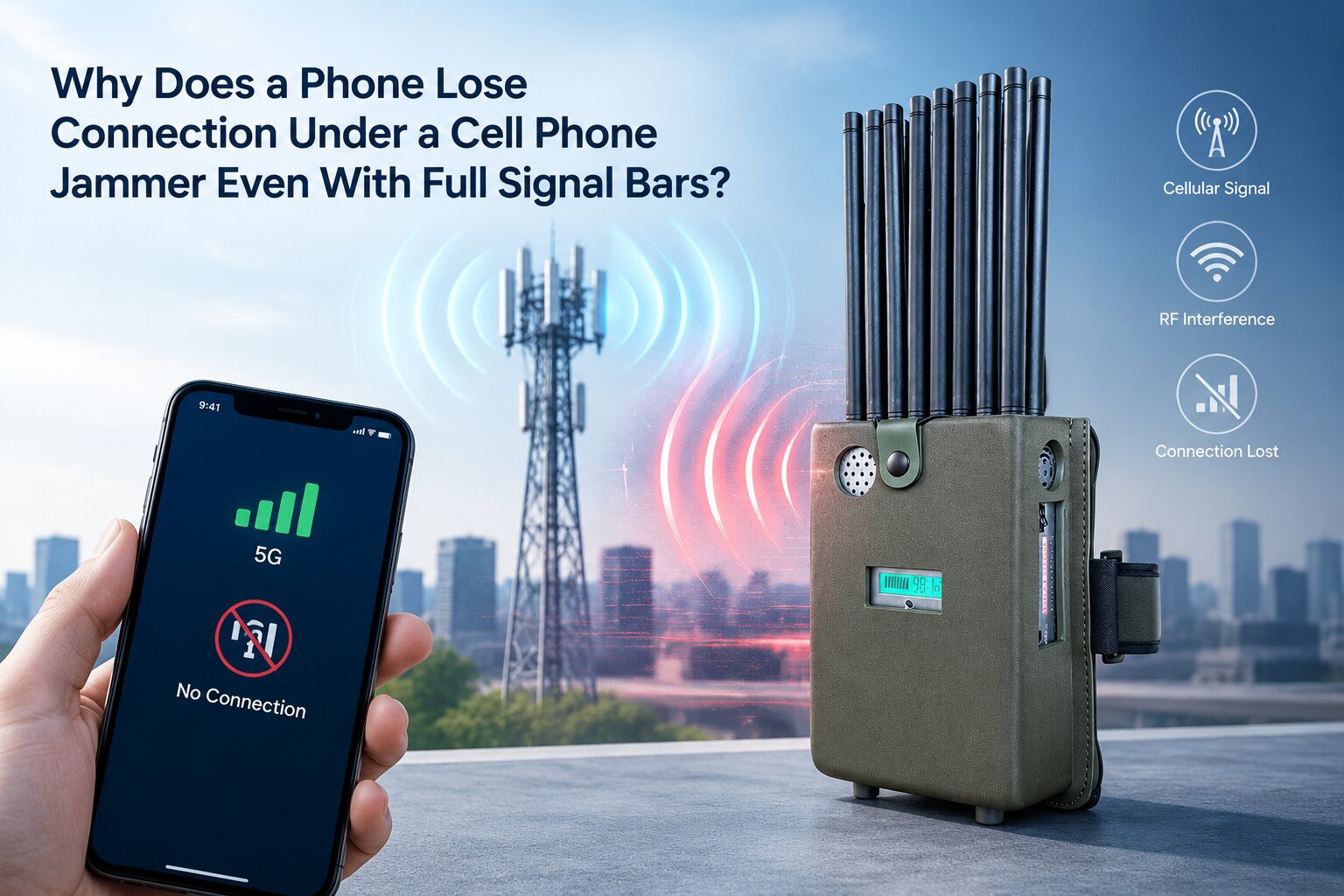
A common misunderstanding is that signal bars represent the complete health of a mobile connection. In reality, phones evaluate several radio measurements and convert them into a simple icon that users can quickly understand. Different manufacturers and carriers may also use different methods to display signal levels.
For LTE and 5G networks, engineers often look at measurements such as:
| Signal Metric | Meaning | Why It Matters |
|---|---|---|
| RSRP | Reference Signal Received Power | Shows the strength of a cellular reference signal |
| RSRQ | Reference Signal Received Quality | Shows signal quality affected by interference |
| SINR | Signal-to-Interference-plus-Noise Ratio | Indicates how usable the signal is for data transfer |
| RSSI | Total received signal strength | Includes signals and background noise |
A mobile phone does not communicate with a cell tower in only one direction. It constantly exchanges information:
Phone → Cellular Tower
Cellular Tower → Phone
The device needs both sides of this communication process to work correctly.
Mobile network blockers affects this wireless communication environment by introducing RF interference in targeted frequency ranges. When interference becomes strong enough, the phone may have difficulty maintaining a stable connection with the network.
The result can be:
| Phone Status | What Users May Experience |
|---|---|
| Signal bars still visible | Phone detects cellular energy nearby |
| Calls fail | Communication link cannot be maintained |
| Data stops loading | Network transmission becomes unstable |
| Connection repeatedly drops | Device struggles to complete exchanges with the tower |
This is the part that surprises many users.
Imagine standing near a radio station. You can receive a strong broadcast signal, but if another strong transmission overlaps the same frequency area, the audio quality can become unusable.
Mobile networks work in a similar way.
A smartphone affected by a cellular phone blocker may still detect:
But the actual connection depends on more than simply detecting a signal.
The phone also needs:
| Situation | Signal Strength | Signal Quality | Result |
|---|---|---|---|
| Near a cell tower | High | High | Stable connection |
| Far from tower | Low | Medium/Low | Slow or unstable connection |
| Strong signal + interference | High | Low | Connection problems |
| Weak signal + heavy congestion | Medium | Low | Poor performance |
The key point:
Signal strength tells you how much signal is received. Signal quality tells you how usable that signal is.
A smartphone showing full signal bars only means the device detects a cellular signal. It does not guarantee that the connection will remain stable when affected by wireless jamming or a mobile phone blocker.
Mobile communication depends on a combination of signal strength, signal quality, frequency conditions, and network performance.
When RF interference affects the communication link, a phone may continue displaying signal bars while losing the ability to maintain normal network connections.