Jammer Deals | Affordable Picks | Free Shipping
Your privacy is our top concern! We offer dependable solutions to safeguard you from unauthorized monitoring, ensuring your confidentiality in any setting.
Jammer Deals | Affordable Picks | Free Shipping
Your privacy is our top concern! We offer dependable solutions to safeguard you from unauthorized monitoring, ensuring your confidentiality in any setting.
Most people still think of satellite navigation as a single signal that helps smartphones find locations or vehicles follow navigation routes.
In reality, modern satellite navigation relies on multiple frequency bands, each designed for different purposes, accuracy requirements, and operating environments.
As GNSS receivers become more advanced, the simple idea of blocking only one navigation frequency is becoming outdated.
This is one reason why multi-band GPS jammers are receiving more attention among users who need to understand complex satellite signal environments.
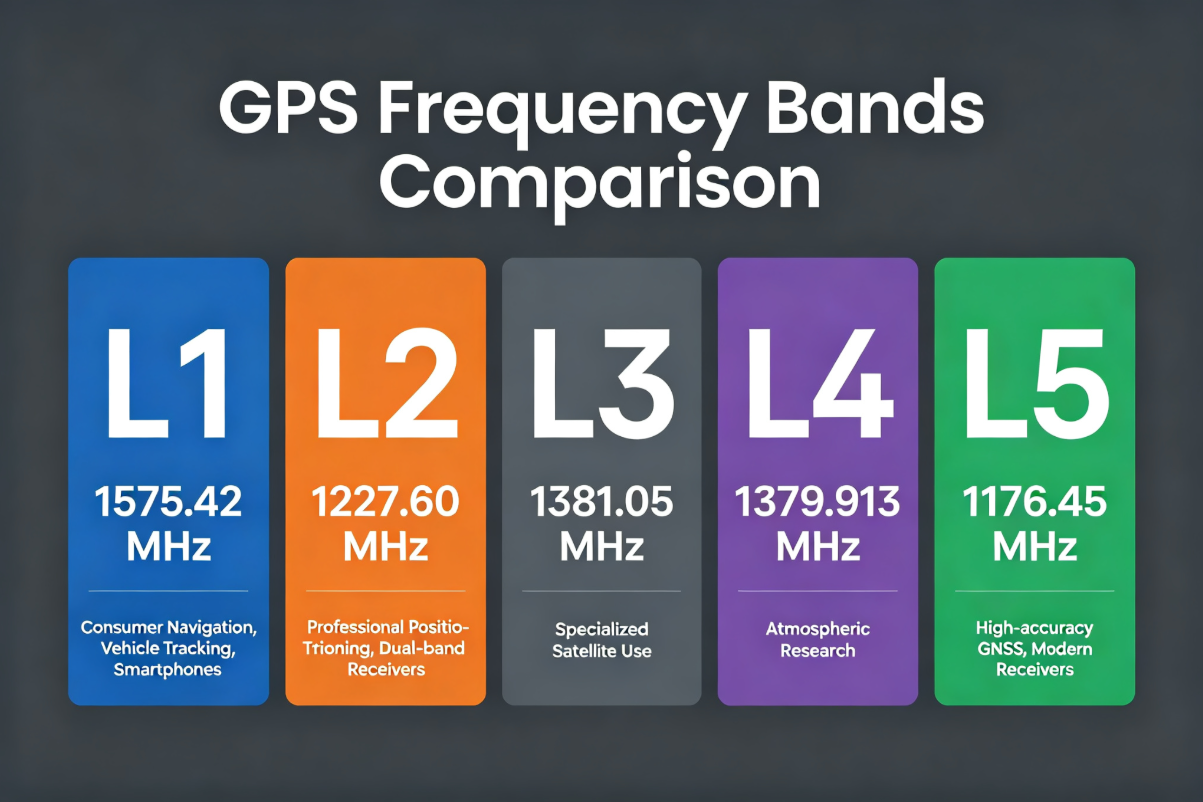
L1 band operates at 1575.42 MHz.
When people talk about location tracking, L1 is usually the frequency they are thinking about. It has been used for decades in:
Because L1 has been around for so long, many early satellite signal products focused mainly on this band. However, modern receivers have changed. A newer device may not depend on L1 alone.
L2 band operates at 1227.60 MHz.
Originally developed mainly for military applications, L2 later became part of modernized GPS services available to civilian users.
The reason L2 matters is simple: using more than one frequency allows receivers to handle certain signal errors more effectively.
This is why professional positioning equipment often uses combinations such as:
Instead of relying on one satellite signal, these systems compare information from different bands.
L3 band operates at 1381.05 MHz.
Unlike L1 and L2, L3 is not a common consumer navigation frequency. It was developed for specialized satellite applications rather than everyday location tracking.
Although most people will never see “GPS L3” listed on a smartphone specification sheet, it shows something important:
GPS was never built around a single simple signal. Different frequencies exist because different tasks require different signal characteristics.
L4 band operates around 1379.913 MHz.
Compared with L1, L2, and L5, L4 is rarely mentioned outside technical discussions. It has been explored for applications related to improving satellite navigation performance, especially research involving atmospheric effects and positioning accuracy.
For everyday users, L4 may not directly affect their device today. But for anyone studying satellite signal technology, it represents another step in the development of multi-frequency navigation.
L5 band operates at 1176.45 MHz.
Among modern positioning device frequencies, L5 receives significant attention because it was developed with improved signal characteristics compared with older GPS generations.
It is increasingly found in newer GNSS receivers used for:
As more receivers support L5, satellite signal reception is becoming more sophisticated than the traditional L1-only approach.
The biggest change in satellite navigation technology is not one specific frequency. It is the move from single-frequency receivers to multi-frequency receivers.
A modern GNSS device may combine signals from:
This means the signal environment around a receiver can be much more complex than it was years ago.
For this reason, many users researching signal equipment are comparing GPS tracker blockers instead of traditional single-frequency models.
GPS is no longer built around one simple frequency.
L1 remains the best-known satellite signal, but L2 and L5 have already changed how modern receivers operate. L3 and L4 may not appear in everyday GNSS products, yet they show how satellite navigation has continued to expand beyond basic positioning.