Jammer Deals | Affordable Picks | Free Shipping
Your privacy is our top concern! We offer dependable solutions to safeguard you from unauthorized monitoring, ensuring your confidentiality in any setting.
Jammer Deals | Affordable Picks | Free Shipping
Your privacy is our top concern! We offer dependable solutions to safeguard you from unauthorized monitoring, ensuring your confidentiality in any setting.
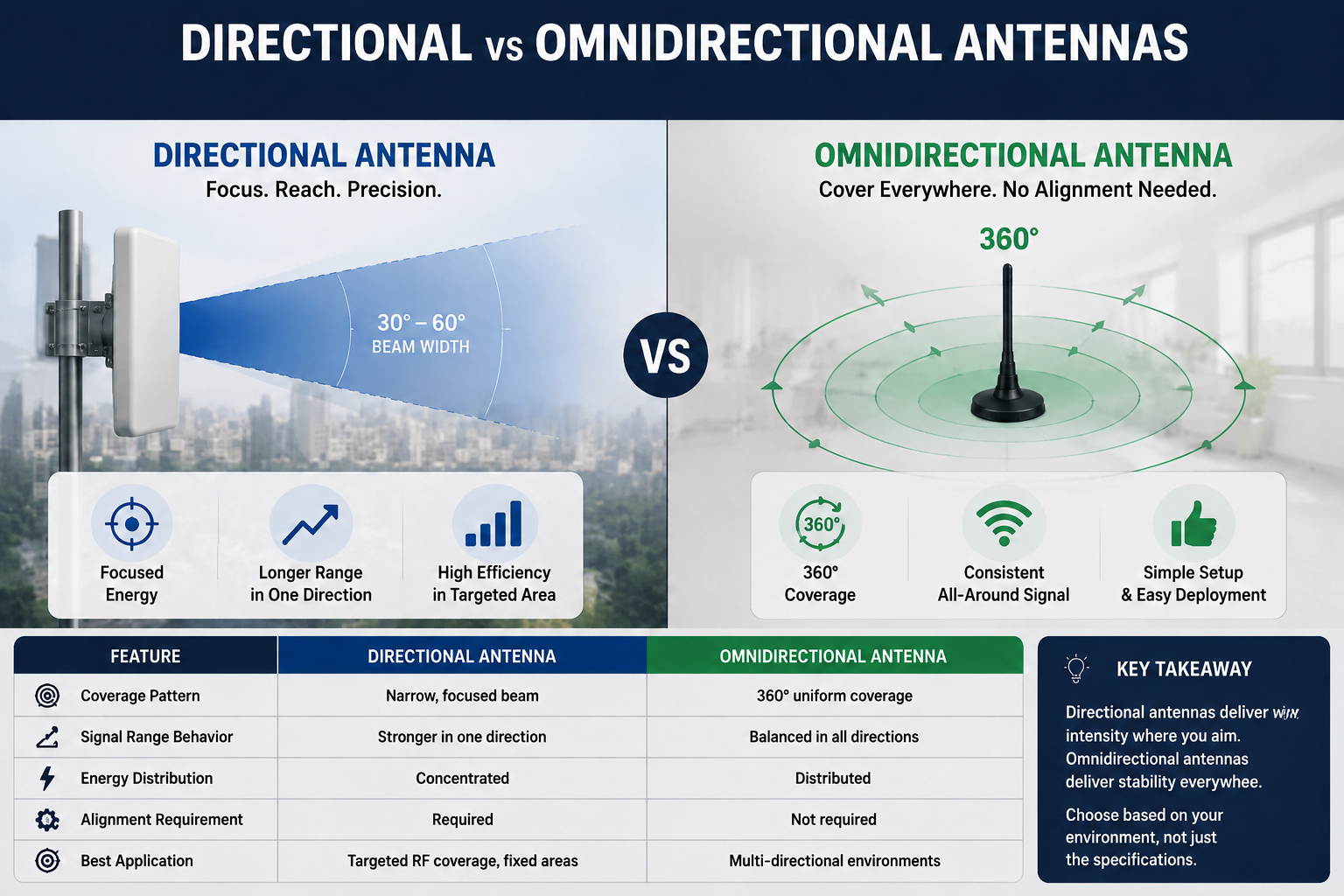
Walk into two identical spaces using different antennas and the result can feel surprisingly uneven. One area gets sharply controlled coverage, while the other feels like the signal is simply “everywhere and nowhere at once.”
The reason is simple: antennas don’t just transmit power—they shape it. And once you notice that, the directional vs omnidirectional debate becomes less about theory and more about real behavior in the field.
One of the key factors often overlooked is how antenna geometry affects signal distribution.
Directional antennas jammers typically operate with a narrower beam width, often ranging between 30° and 60°, depending on design and gain structure.
This concentrated pattern allows energy to travel farther in a single direction, improving effective range within a focused zone.
In contrast, omnidirectional antennas distribute energy across a full 360° horizontal plane.
This naturally reduces peak gain in any single direction, but ensures more consistent coverage across space.
Another important factor is signal attenuation. As distance increases, signal strength decreases more rapidly in omnidirectional setups due to energy dispersion, while directional systems maintain stronger intensity along the main lobe direction.
It transmits signals in all directions. No alignment. No fine-tuning. Just consistent coverage around the source. Like a light bulb installed in a room, radiating light in all 360 degrees.
This simplicity is its strength. In environments where movement is unpredictable, this approach removes complexity entirely. You don’t aim it—you place it.
Of course, there is a balance to consider. Power is shared across all directions, so peak intensity in any single direction is naturally reduced.
Still, in many real-world scenarios, stable all-around coverage matters more than maximum distance in one direction.
Now switch the perspective, it concentrates energy in one direction. Consider this: it's more like a focused flashlight than a light source that radiates in all directions.
The result is a concentrated beam that can extend performance farther in one direction than many expect. This is where efficiency becomes obvious. Energy is not scattered, but aligned.
But there is a trade-off that cannot be ignored. Outside the beam angle, performance drops quickly. One shift in position, and the effect changes dramatically.
So yes, it delivers intensity—but only where it is aimed.
Putting them side by side, the contrast becomes clear almost immediately. One concentrates power. The other distributes it evenly.
And here’s the part we almost forget: neither approach is universally superior.
Directional antennas jammer tend to perform best in controlled environments where the target area is fixed and predictable. Once alignment is correct, efficiency becomes highly noticeable.
Omnidirectional antennas signal blocker, on the other hand, are more suitable when coverage needs to remain stable across all directions, especially in changing or unpredictable environments.
Considering both approaches, the choice is less about “better or worse” and more about matching behavior to environment.
At first glance, element selection looks like a small technical detail. But it actually defines how the entire system behaves.
Directional antennas deliver concentrated performance. Omnidirectional antennas deliver spatial balance. And between those two, the real engineering decision takes shape.
Yes. It's type directly influences coverage shape, range, and energy distribution, which can significantly impact overall performance.
In some configurations, yes. Hybrid setups may combine both types to balance focused coverage with broader spatial distribution.
Omnidirectional antennas are often preferred indoors because walls and obstacles cause signal reflection and scattering. A 360-degree pattern helps maintain more consistent coverage across rooms and partitions.