Jammer Deals | Affordable Picks | Free Shipping
Your privacy is our top concern! We offer dependable solutions to safeguard you from unauthorized monitoring, ensuring your confidentiality in any setting.
Jammer Deals | Affordable Picks | Free Shipping
Your privacy is our top concern! We offer dependable solutions to safeguard you from unauthorized monitoring, ensuring your confidentiality in any setting.
Those unfamiliar with cell phone blockers might assume they only affect voice calls or mobile data networks.
However, some people might wonder: do they also interfere with Wi-Fi and GPS signals?
The answer is yes; it depends on the jamming device's frequency range and hardware configuration.
How does a device handle different wireless signals?
The reason is simple: different wireless technologies communicate using different frequency ranges.
For example, cellular communication, Wi-Fi connections, and GPS positioning signals operate independently:
| Signal Type | Main Purpose | Common Frequency Range |
|---|---|---|
| Cellular | Calls and mobile data | 2G / 3G / 4G / 5G bands |
| Wi-Fi | Wireless network connection | 2.4GHz / 5GHz |
| GPS | Satellite positioning | GPS L1 / L2 / L5 |
A smartphone may use cellular networks for calls and mobile data, connect to a Wi-Fi router for internet access, and receive GPS satellite signals for positioning.
Since these signals operate at different frequencies, multi-band mobile phone silencer require separate RF channels to cover each frequency band.
Each channel handles a specific band, enabling the system to operate across multiple wireless frequency bands simultaneously.
As you can see, these technologies are not interchangeable. A device that covers cellular frequencies may have no effect on Wi-Fi or GPS unless those bands are included.
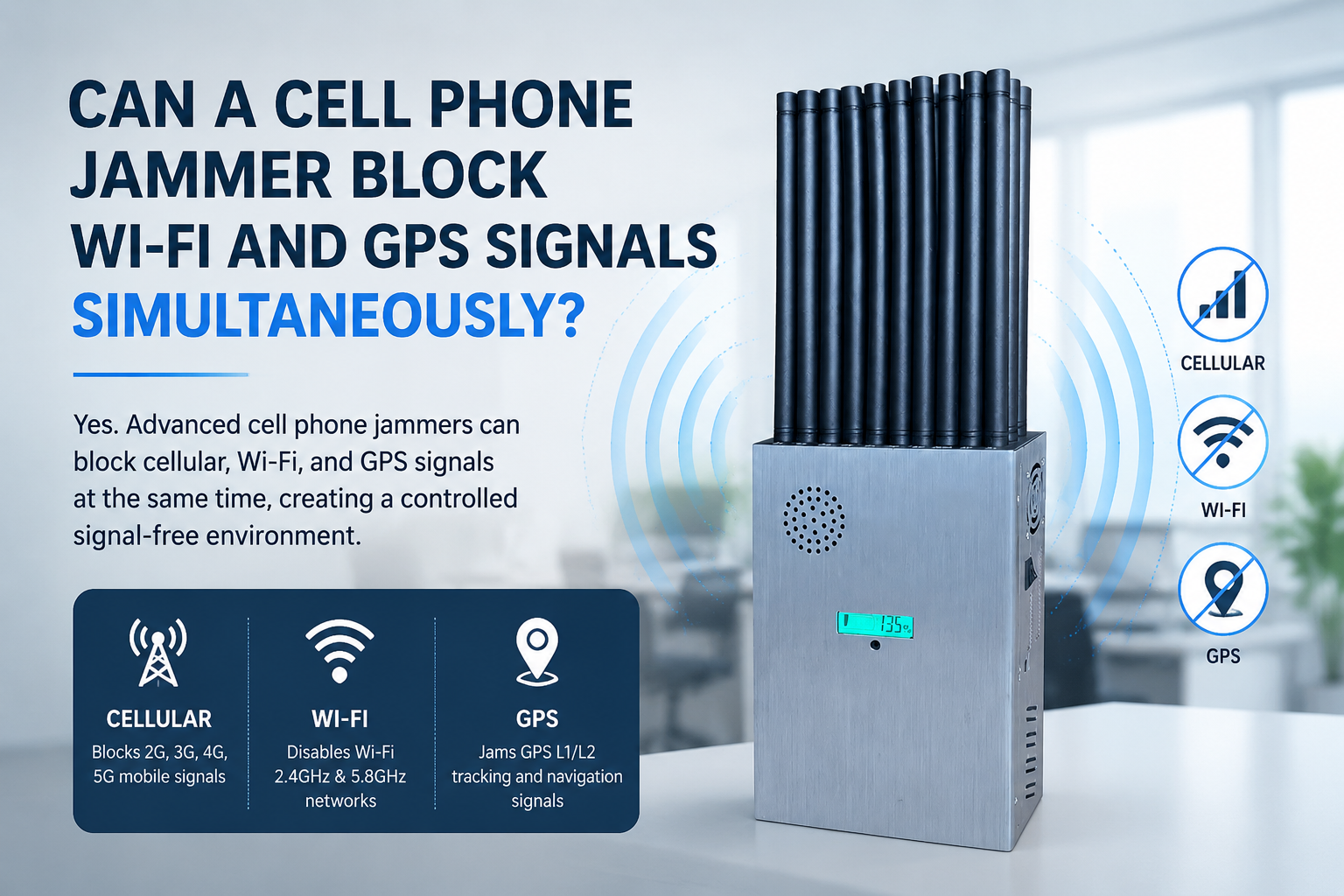
Some advanced models can support cellular, Wi-Fi, and GPS frequency coverage simultaneously. However, this depends entirely on the actual specifications of the signal blocking equipment.
The thing is, many people assume a “phone signal blocker” automatically blocks every wireless frequency around it. That is not how RF technology works.
A basic full-band cellular jammer may only include frequency bands related to:
GSM networks
3G communication
4G LTE
5G mobile signals
A multi-band model may add support for:
Wi-Fi 2.4GHz
Wi-Fi 5GHz
GPS L1
GPS L2+L5
GPS L3+L4
So basically, the wider the frequency configuration, the more types of wireless signals the device can cover.
Compared with a single-purpose jamming device, a multi-band system provides broader coverage because it combines several independent frequency paths into one device.
This is where many misunderstandings happen.
Cellular signals connect smartphones with nearby mobile towers. When you make a call or use mobile data, your phone communicates with the carrier’s network.
Wi-Fi works differently. It creates a local wireless connection between devices and a router. Most consumer Wi-Fi networks operate around 2.4GHz and 5GHz frequencies.
GPS is even more different. Instead of connecting to a nearby device, a GPS receiver listens to extremely weak signals transmitted from satellites.
Take GPS as an example. A GPS receiver is not sending information back to satellites like a phone connects to a tower. It is mainly receiving positioning signals.
Because of this, GPS requires completely different frequency coverage compared with cellular communication. If you need to specifically block GPS signals, the device needs a dedicated GPS frequency channel.
This is one of the most common misunderstandings.
Many basic 5G signal jammers focus only on cellular frequency. They may block certain mobile communication bands but have no dedicated channels for Wi-Fi or GPS frequencies.
A user looking for broader coverage should pay attention to:
The product description alone is not enough. The frequency list tells the real story.