Jammer Deals | Affordable Picks | Free Shipping
Your privacy is our top concern! We offer dependable solutions to safeguard you from unauthorized monitoring, ensuring your confidentiality in any setting.
Jammer Deals | Affordable Picks | Free Shipping
Your privacy is our top concern! We offer dependable solutions to safeguard you from unauthorized monitoring, ensuring your confidentiality in any setting.
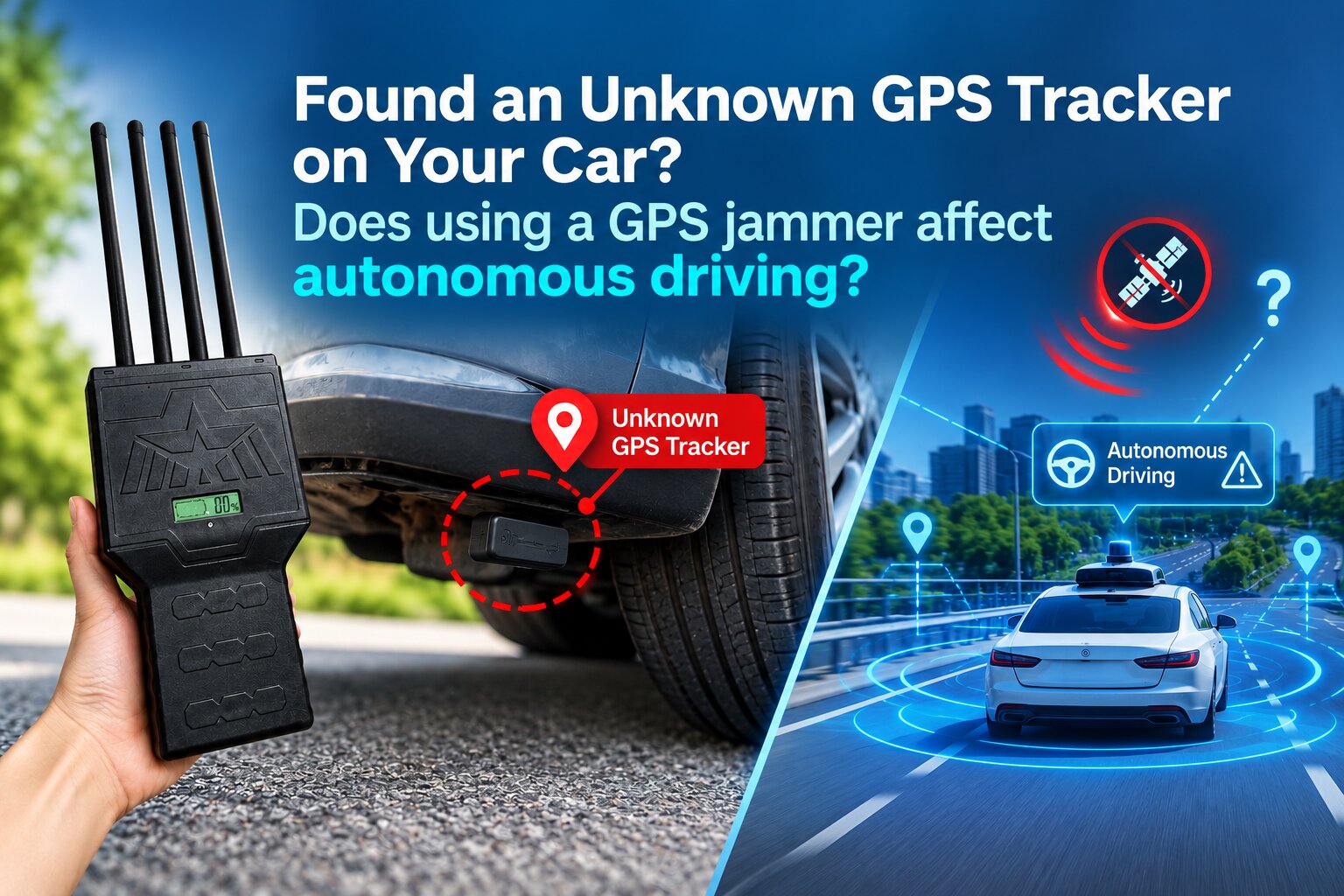
Finding an unfamiliar GPS tracker attached to your vehicle can raise immediate concerns. Who installed it? Is it recording your location? And if the device relies on satellite signals, would using a GPS jammer to block these signals affect the vehicle’s navigation or driver-assistance systems?
A GPS tracker may report a vehicle's location to a fleet manager, while an automated driving system uses satellite navigation alongside cameras, radar, LiDAR, and other sensors to understand where the vehicle is and how it is moving.
However, they can share one important dependency: access to reliable positioning information from Global Navigation Satellite Systems (GNSS), including GPS.
A GPS tracker generally calculates its position by receiving signals from navigation satellites. Depending on its design, it then transmits location data through a cellular or another communications connection.
If a GPS and GLONASS jammer for L1-L5 is used, causing satellite signal reception to become unstable, the tracker may be unable to obtain new GPS location fixes. Its application might display the last known location, report an error, or show no current position.
Potentially, yes—but the effect is not as simple as switching off a navigation system.
Satellite positioning can help an automated vehicle establish its geographic location. When that input becomes unreliable, the vehicle may have less confidence in its estimated position, particularly in situations where precise localization is important.
Modern automated driving systems can draw on other sources of information, including:
These technologies provide complementary information, but none is a universal replacement for GPS. Cameras can struggle with poor visibility, inertial estimates accumulate error over time, and wheel-speed measurements can be affected by wheel slip.
A GPS jammer therefore should not be described as a device that automatic ally disables an autonomous vehicle.
A GPS tracker and an autonomous driving system may both rely on satellite positioning, but they do different jobs.
GPS location blocker can prevent a standalone tracker from reporting a reliable GPS-derived location without necessarily disabling the vehicle's onboard navigation or driving functions.