Jammer Deals | Affordable Picks | Free Shipping
Your privacy is our top concern! We offer dependable solutions to safeguard you from unauthorized monitoring, ensuring your confidentiality in any setting.
Jammer Deals | Affordable Picks | Free Shipping
Your privacy is our top concern! We offer dependable solutions to safeguard you from unauthorized monitoring, ensuring your confidentiality in any setting.
A conference room with glass walls, a private office with carpet flooring, and an empty meeting space with concrete surfaces can produce completely different acoustic conditions.
Since audio jammers work through acoustic signals received by microphones, the surrounding environment directly influences how those signals travel and interact with recording devices.
Sound does not travel through a room in a straight line only. After leaving an audio source, sound waves can be:
| Acoustic Effect | What Happens | Impact on Anti Listening Device Performance |
|---|---|---|
| Direct sound | Signal travels directly from the device to the microphone | Usually provides the strongest interaction |
| Reflection | Sound bounces from walls, ceilings, and furniture | Can create uneven sound distribution |
| Absorption | Materials such as curtains and carpets reduce sound energy | May decrease reflected acoustic energy |
| Reverberation | Multiple reflections continue after the original sound | Changes how microphones receive signals |
Room acoustics are commonly measured through factors such as reverberation time (RT60) , which describes how long sound remains in a room after the original source stops.
Studies on conference rooms show that excessive reverberation can significantly affect speech-related acoustic performance.
For an audio privacy device, this means the same equipment may perform differently in two rooms with identical dimensions but different interior materials.
One of the easiest ways to understand acoustic differences is to compare room surfaces.
A modern office often contains:
Glass partitions
Metal frames
Wooden desks
Large monitors
Concrete or painted walls
These materials reflect more sound energy and create stronger acoustic reflections.
By contrast, rooms with:
Carpets
Fabric chairs
Curtains
Acoustic panels
usually absorb more sound.
Imagine two 4-person meeting rooms:
| Room Type | Typical Features | Acoustic Characteristics |
|---|---|---|
| Glass conference room | Glass walls, hard table, minimal decoration | More reflections, longer reverberation |
| Private office | Carpet, curtains, upholstered furniture | More absorption, reduced reflections |
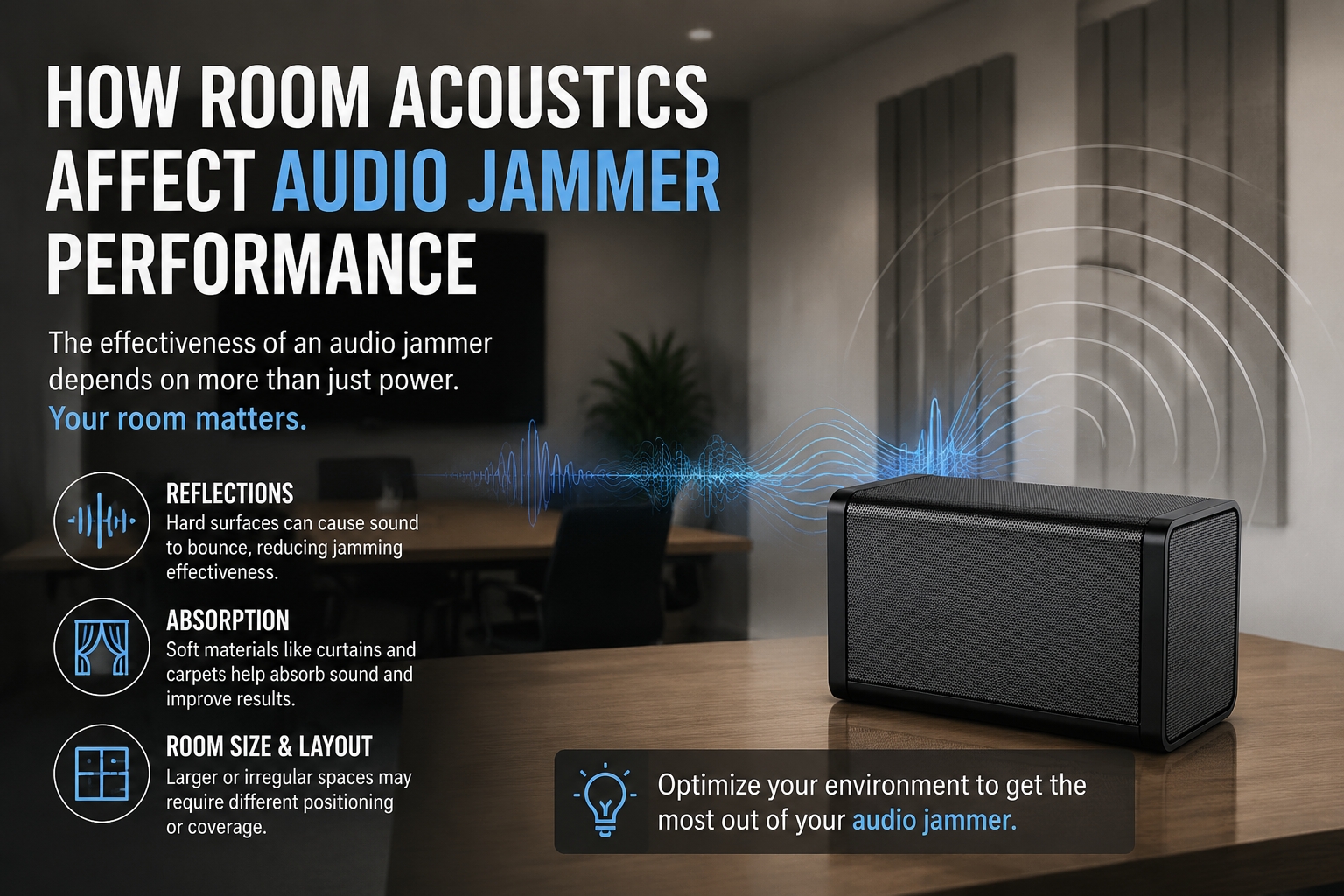
The size of a room changes how acoustic signals behave.
A small private office and a large conference room require different considerations.
Small Rooms
Common examples:
Executive offices
Consultation rooms
Small meeting rooms
Characteristics:
In these spaces, a compact portable digital signal blocker to jams voice recording may be suitable depending on the application and room layout.
Larger Rooms
Common examples:
Boardrooms
Training rooms
Open meeting areas
Challenges:
Large spaces often require more careful placement and evaluation of coverage rather than simply increasing power.
Many users focus on the room but overlook one important factor: where the microphone is located.
Recording devices are not always placed in the same position.
Examples:
| Recording Device Location | Acoustic Condition |
|---|---|
| On a conference table | Receives direct and reflected signals |
| Near a wall | May receive stronger reflections |
| Inside a bag or hidden location | Different acoustic characteristics |
| Close to the speaker | Stronger voice signal |
Before choosing equipment, users can check several practical factors.
| Evaluation Factor | Questions to Ask |
|---|---|
| Room size | Is it a small office or large conference room? |
| Wall materials | Are walls mainly glass, concrete, or fabric-covered? |
| Furniture | Are there carpets, curtains, or upholstered chairs? |
| Operating time | Will it be used for short meetings or longer sessions? |
A simple room evaluation often provides more useful information than looking at a single specification number. You might also want to contact us, and we will select the best option for you.
Different environments place different demands on sound privacy equipment.
| Environment | Important Considerations |
|---|---|
| Private office | Compact size, easy placement |
| Meeting room | Balanced coverage and stable operation |
| Large conference room | Wider acoustic distribution and careful positioning |
| Mobile use | Battery operation and portability |
The best choice depends on the combination of device capability and the acoustic characteristics of the location.
We particularly recommend this ultrasonic audio jammer for anti-recording protection with 66 emitters—which provides 360-degree, omnidirectional coverage against microphones while allowing for independent, selective control (front, back, left, and right).
Of course, we also have a recommendation for smaller rooms: the ultrasonic recording jammer with 37 emitters, which likewise offers a 360-degree jamming range.