Jammer Deals | Affordable Picks | Free Shipping
Your privacy is our top concern! We offer dependable solutions to safeguard you from unauthorized monitoring, ensuring your confidentiality in any setting.
Jammer Deals | Affordable Picks | Free Shipping
Your privacy is our top concern! We offer dependable solutions to safeguard you from unauthorized monitoring, ensuring your confidentiality in any setting.
A private conversation used to have one main risk: someone might secretly record it.
Today, the problem has become more complicated.
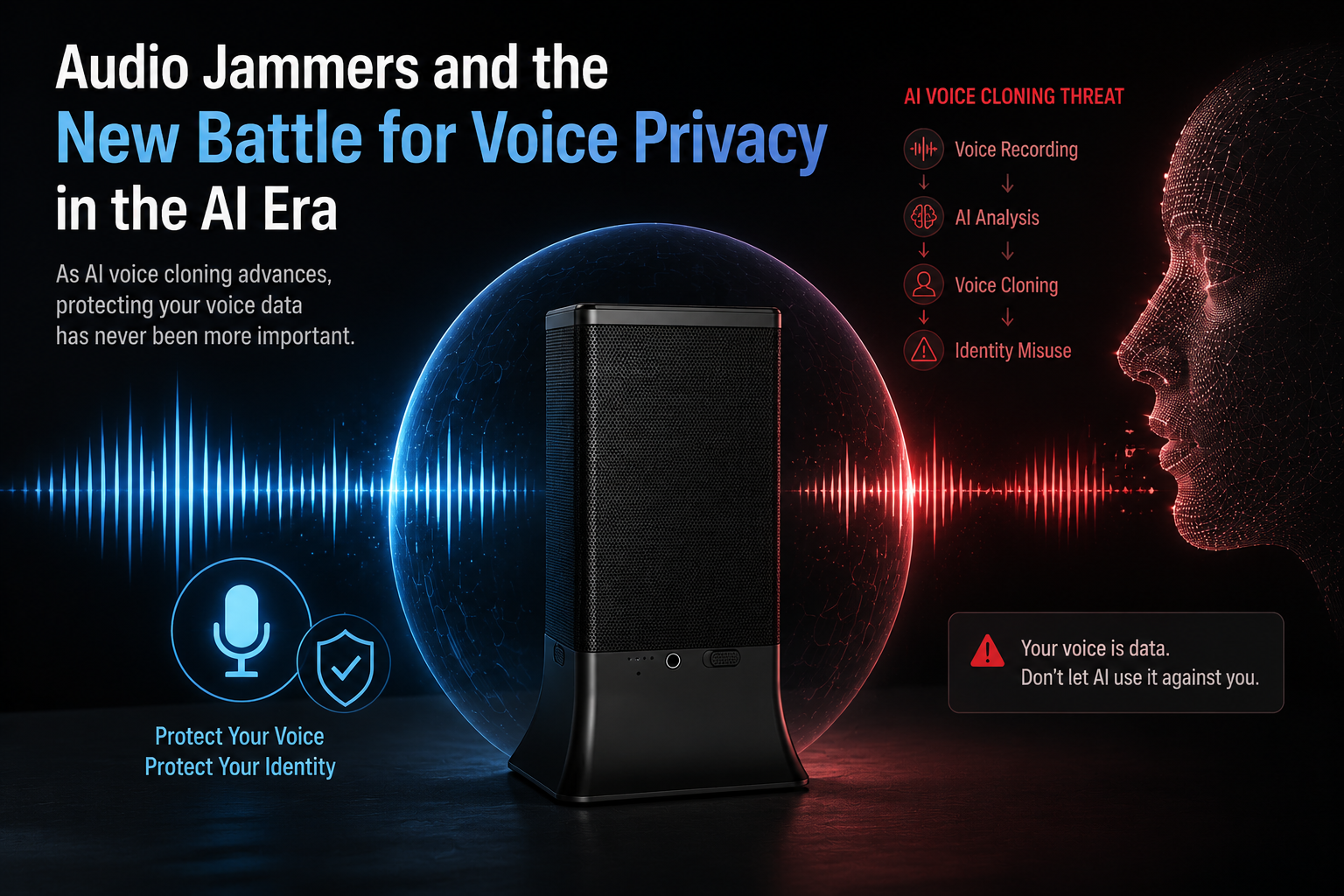
In this AI era, even short audio samples can reveal enough speech patterns, intonation, and speaking style to create realistic synthetic speech.
A 2025 Consumer Reports assessment of AI voice cloning services found that several platforms lacked sufficient safeguards against unauthorized voice replication, showing how easily voice data can become a privacy concern when proper protections are missing.
This has led some businesses and professionals to consider audio signal blocker as an additional layer of protection for confidential conversations.
Not every conversation needs the same level of protection.
A casual conversation may have little impact if it is recorded. However, a confidential discussion inside a company can contain information that directly affects business decisions.
Examples include:
Product development plans
Investor negotiations
Legal discussions
Executive meetings
Private interviews
Research projects
Unlike a leaked document, a leaked conversation can be harder to control. Once recorded, it can be copied, converted into text, analyzed by AI tools, or used as a source for voice imitation.
This is why more organizations are looking beyond traditional cybersecurity and paying attention to audio privacy protection as part of their overall security strategy.
IBM’s Cost of a Data Breach Report 2025 found that the global average cost of a data breach remained around $4.4 million, while many organizations continued to struggle with AI-related security controls.
Traditional privacy methods usually focus on physical control:
But AI has changed the way people think about recorded conversations.
The question is no longer only:
“Was someone recording?”
It is also:
“What could someone do with that voice data?”
A conversation may contain more than words. It can reveal:
This is why modern privacy protection is moving from simple recording prevention toward protecting the value of voice information itself.
Microphones are now everywhere. They are built into smartphones, smart watches, wireless earbuds, conference equipment, and portable recording devices.
For private offices, meeting rooms, and confidential discussions, this creates a new challenge: preventing unwanted audio capture without interrupting normal communication.
Unlike ordinary white audio Jammer with White Noise Generator and 6 Speakers that simply add background sound, anti recording device are designed specifically for privacy-focused environments where reducing microphone recording quality is the priority.
In the past, protecting information meant securing files, passwords, and networks.
Now, a person’s voice can also become valuable digital information.
For executives, companies, and professionals handling confidential discussions, audio bugs jammer (37 emitters ultrasonic anti listening device) provide another layer of privacy protection in situations where conversations cannot be exposed.
The future of privacy may not depend only on controlling where information is stored. It may also depend on controlling what information is captured in the first place.